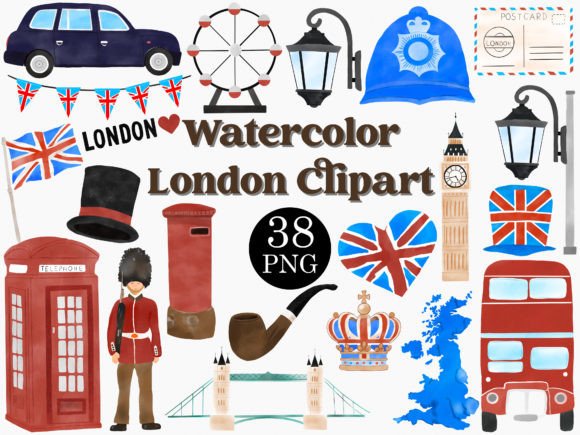
Watercolor London Clipart Set: An Embroidery Review
As a professional embroidery designer and product reviewer, I approach every new digital asset with a healthy dose of skepticism. The market is flooded with beautiful screen graphics that simply cannot translate to thread. When I first opened the Watercolor London Clipart Set, my immediate question was not about its aesthetic beauty—which is undeniable—but about its structural integrity for needle and thread. This collection falls under the category of Illustrations, and while it captures a dreamy, romanticized view of British landmarks and street scenes, my job is to determine if that watercolor wash can survive the rigors of a commercial embroidery project or a cherished personalized gift.
First Impressions: Mood Versus Mechanics
The visual personality of this set is soft, nostalgic, and distinctly artistic. Unlike rigid architectural line art, these illustrations rely on color blending and organic edges to create depth. For an Etsy seller or boutique owner, this mood is gold. It suggests high-end craftsmanship and vintage charm rather than mass-produced tourist merchandise. However, translating watercolor effects into a machine embroidery design requires careful interpretation. The "bleed" of paint in the digital file must be converted into either complex fill stitch gradients or, more practically, applique design elements with printed fabric backgrounds.
When evaluating this set for real-world use, I look at the shape language. Are the landmarks distinct enough to be recognized at three inches wide? Do the intricate details of Big Ben or Tower Bridge get lost when reduced for a baby embroidery project? In my assessment, the Watercolor London Clipart Set excels at medium-to-large formats where the artistic intent remains clear. The softer edges actually work in favor of embroidery, as they allow for more forgiving registration between fabric patches and satin stitch borders compared to sharp, geometric vectors.
Real-World Application: The Custom Tote Bag Test
To truly evaluate this asset, I mentally prototyped a specific scenario: creating a premium canvas tote bag for a wedding welcome gift. This is a common request for craft business owners and requires a balance of durability and elegance. A tote bag design needs to withstand weight and washing while looking sophisticated.
Using this clipart set for such a project offers significant value. Instead of a generic Union Jack, the watercolor aesthetic provides a bespoke, handmade product feel that justifies a higher price point. For sweatshirt embroidery or apron customization, the soft color palette pairs beautifully with neutral linens and creams. However, I would advise against using the full-color digital version directly as a stitch file without modification. The best results for this specific application come from treating the clipart as a guide for a mixed-media approach. Use the illustration to print fabric for an applique center, then frame it with coordinating thread colors in a running stitch or light satin stitch. This preserves the watercolor magic without creating a bulletproof vest of dense stitches on a lightweight garment.
Navigating Fabric Limitations and Hoop Sizes
While the Watercolor London Clipart Set is versatile, it demands respect for fabric physics. If you are planning custom apparel on stretchy knits or performance wear, caution is necessary. Watercolor-style designs often imply large areas of coverage. On thin or stretchy fabric, this stitch density can cause puckering, distortion, or even tearing. Always pair this design type with appropriate stabilizer; a cut-away mesh is often superior to tear-away for maintaining the drape of the finished product.
Small hoop sizes present another challenge. Reducing these illustrations below four inches risks muddying the visual clarity. Tiny lettering on shop fronts or fine architectural lines will disappear into a blob of thread. If your project requires small-scale embroidery, such as a collar accent or pocket logo, select only the simplest icons from the set rather than forcing a complex scene into a 2x2 hoop. Conversely, for large hoop sizes like jacket backs or pillow covers, ensure your digitizing software supports the expanded canvas without hitting machine limits. Always confirm the maximum dimensions before purchasing or stitching to avoid disappointment.
Commercial Viability and Customer Perception
For creative entrepreneurs and digital product sellers, the licensing and presentation of this set are critical. Before listing any finished product or digital embroidery file derived from these assets, verify the commercial terms explicitly. Customers trust brands that deliver consistent quality. If you sell a printable mockup featuring this London theme, ensure the actual stitched result matches the promise. The gap between a crisp digital preview and a poorly executed stitch-out is where buyer engagement dies.
Professionally, this set elevates brand consistency for UK-themed businesses or travel-inspired collections. It signals attention to detail. However, value perception relies on execution. A watercolor design stitched with poor tension or mismatched thread colors looks cheap. To maintain professionalism, test thread colors against the specific fabric texture you intend to use. Matte threads often mimic watercolor better than high-sheen rayon. For holiday embroidery or seasonal merchandise, consider how these timeless illustrations can be adapted with subtle festive accents without losing their core identity.
Essential Designer Notes for Success
Before committing the Watercolor London Clipart Set to production, adhere to these practical protocols to ensure your embroidery project succeeds:
- Test Stitch on Scrap: Never run a new design on a final product first. Use similar fabric weight and weave to check for registration issues and density problems.
- Analyze Stitch Density: If converting the illustration yourself, keep fill stitch density moderate. Watercolor should look airy, not armored. Underlay stitches are crucial for preventing fabric show-through.
- Contrast Check: Review the design in grayscale. If the image loses definition without color, the contrast relies too heavily on hue rather than value. Adjust your digitizing to include tonal variation.
- Stabilizer Selection: Match stabilizer to fabric, not just design size. Textured fabrics like linen may require a topping to prevent stitches from sinking and obscuring fine details.
- Mockup Reality Check: Create black and white mockups alongside color versions. This helps identify whether the design stands on structure alone, which is vital for single-color embroidery options.
- Licensing Verification: Double-check if the license covers selling physical embroidered items versus digital files. These are often separate permissions for Etsy sellers and small shop products.
- Thread Color Matching: Physical thread charts differ from RGB screens. Build a physical thread palette before digitizing to ensure the "watercolor" effect translates accurately to polyester or cotton threads.
Ultimately, the Watercolor London Clipart Set is a powerful tool for makers who understand the translation process from pixel to stitch. It offers a unique opportunity to create emotionally resonant, high-value items that stand out in a saturated market. By respecting the technical constraints of embroidery and leveraging the set’s inherent artistic strengths, you can produce finished products that delight customers and reflect true craftsmanship. Whether for a personalized gift or a commercial embroidery line, success lies in thoughtful adaptation rather than direct replication.